Digital Wayfinder — Expo 2020, DIFC & Mall of the Emirates
Branded digital directory and smart wayfinding interfaces for some of the region's most visible destinations — Expo 2020 Dubai, DIFC, and Mall of the Emirates. Iconography, visuals, pitch mockups, and clickable prototypes, from discovery through developer-ready specs.
Client
Abuzz Technology
Year
2023–2024
Type
UX Design
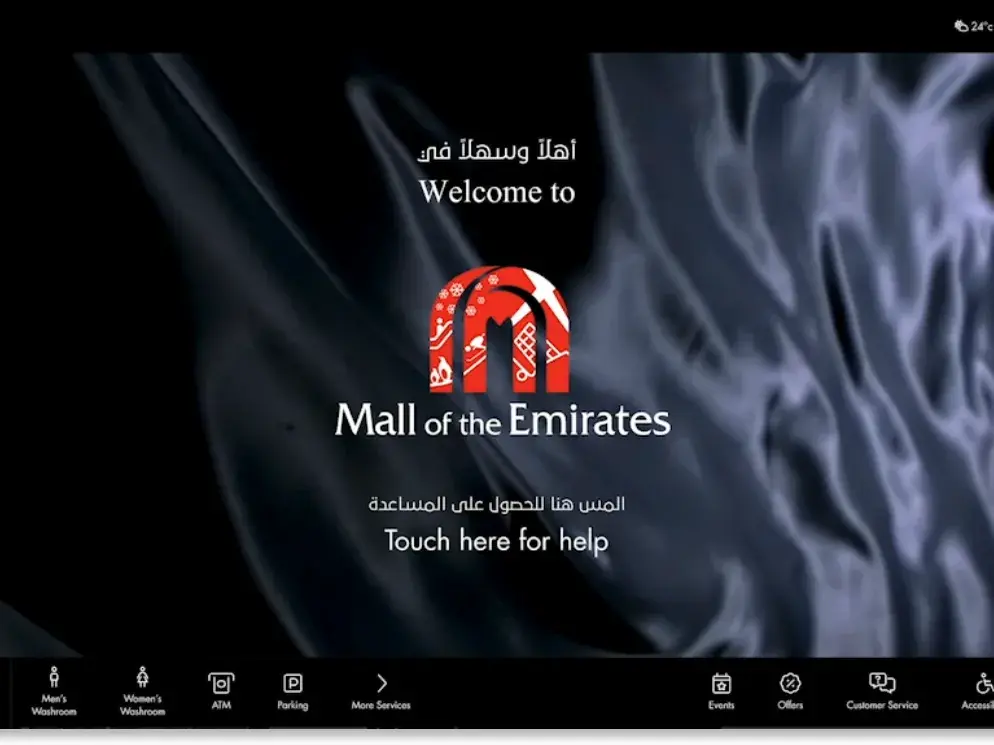
Branded digital directory and smart wayfinding interfaces for some of the region's most visible destinations — Expo 2020 Dubai, DIFC, and Mall of the Emirates. Iconography, visuals, pitch mockups, and clickable prototypes, from discovery through developer-ready specs.
Abuzz sells wayfinding into commercial, retail and public environments across the Middle East and Asia. Every deployment is a different venue with a different brand and a different content model, running on the same underlying product.
The venues in this period included Mall of the Emirates, Expo 2020 Dubai, DIFC and the Dubai World Trade Centre. A mall visitor looking for a shoe shop, an Expo visitor deciding which pavilion to queue for, and a DIFC office worker locating a meeting room want visibly different things from one product.
The first piece of work was separating what belongs to the product from what belongs to the venue — an audit question more than a design one, and the thing that determined whether the rest scaled.
The product had to be brandable without being rebuilt. If every new venue became a bespoke design project, the business could not sell it, and the design would drift apart across installations within a year.
Expo and DIFC pushed hardest in opposite directions. Expo needed live events, Al Wasl light show and fireworks times, and a site map covering an entire district. DIFC needed a business-district directory in a quieter, more corporate register.
Sales needed to show the product before a given version of it existed. In this market bids are won on mock-ups, so the design process had to produce credible artefacts early enough to be useful commercially.
I defined a themable core — navigation, map, search, on-screen keyboard, service icons, accessibility controls and language toggle — with a venue layer sitting over it for identity, imagery and content types.
The iconography was drawn as a set rather than one icon at a time, so a venue adding an unusual service didn’t break the visual rhythm of the row it landed in.
The constraints carried over from earlier kiosk work still applied: reachable controls, an accessibility height mode, genuine Arabic/English parity, and a QR handoff so a visitor could continue on their own phone.
For bids I built clickable prototypes rather than slides. Letting a stakeholder walk the flow answers the questions a deck creates, and it surfaces disagreements while they are still cheap to resolve.
The hardware set the canvas. The kiosk enclosure drawings — the physical screen aperture and its mounting height — defined the real design surface, so the interface was drawn to that rather than to a convenient artboard.
One wayfinding product deployed across venues with very different brands, audiences and content needs, without forking into bespoke builds.
Expo 2020’s Smart Directory ran the same core as a shopping mall directory, themed and populated differently.
Clickable prototypes became the standard artefact for bids, replacing static presentation mock-ups.
The icon set and themable core gave the business a repeatable way to onboard a new venue rather than starting from a blank file.
Want the detail behind any of this?
Discuss this project